COD Fraud in Pakistan Starts With a Fake Address | Shopify
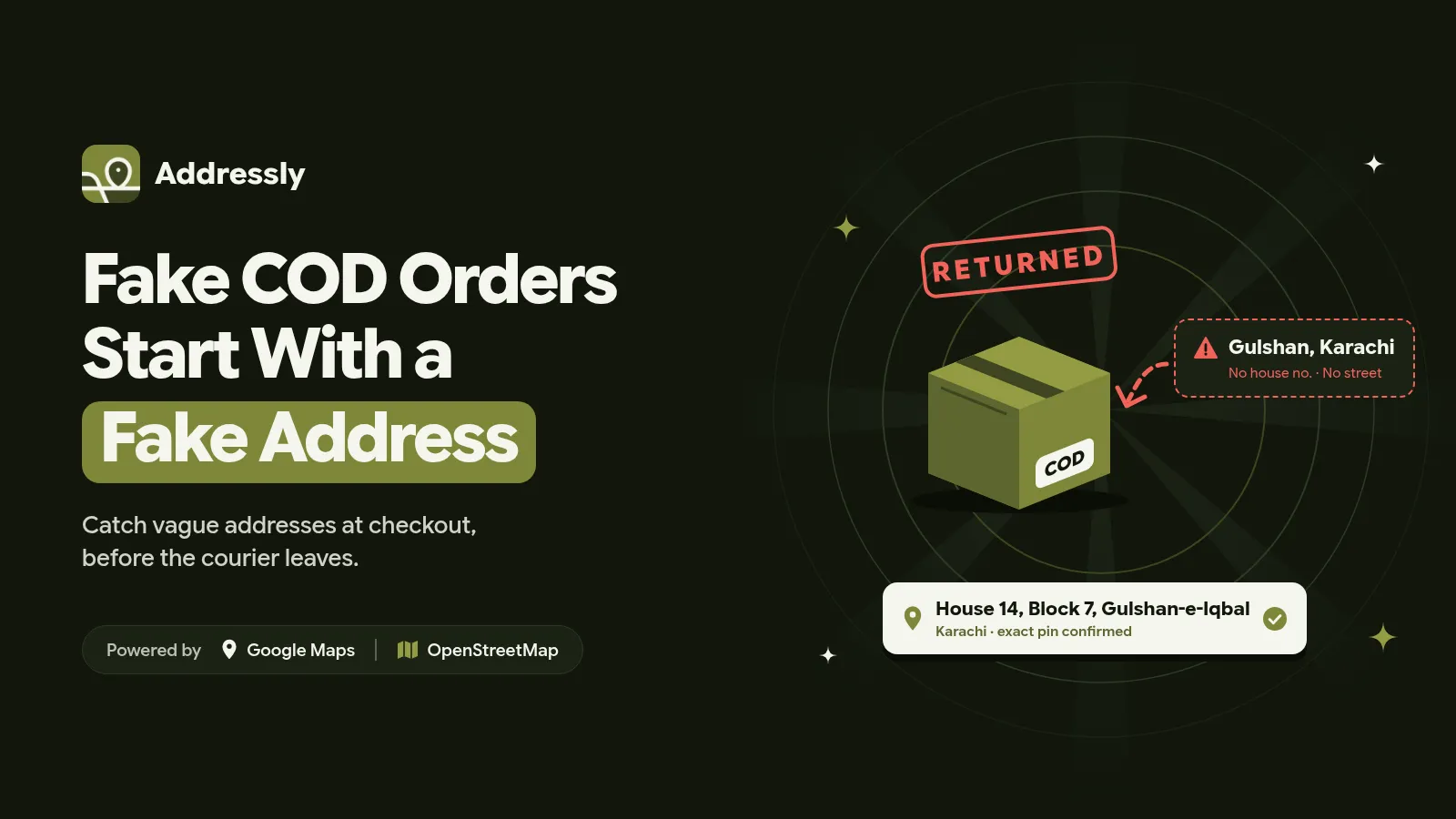
Fake and vague addresses drive COD returns in Pakistan. Learn why address quality is an early fraud signal and how Shopify stores can fix it at checkout.
Why Cash-on-Delivery Fraud in Pakistan Often Starts With a Fake or Vague Address
TL;DR: In COD-heavy markets like Pakistan, industry estimates often put return-to-origin (RTO) rates somewhere between 20% and 45%. Many failed and fake COD orders share one trait: the address was never deliverable. Adding more checkout fields doesn't fix it. Capturing an accurate address as the customer types does. Addressly, a Built for Shopify app, adds real-time address autocomplete (Google Maps and OpenStreetMap), one-tap GPS and a map pin for the exact drop-off point, so COD orders arrive with addresses a rider can actually find. It works for stores worldwide, from $6.99/month with a 7-day free trial.
If you run a Shopify store in Pakistan and rely on Cash on Delivery, you already know the numbers can be brutal. Estimates vary by source, but industry estimates commonly put COD return-to-origin rates somewhere between 20% and 45%. Look into why so many of these orders get refused, returned or turn out to be fake, and one thread keeps showing up: the address was never real to begin with.
Most merchants treat address problems and fraud problems as two separate things. They usually aren't. In a COD-heavy market, a bad address is often the first sign of a fraudulent or low-intent order, and fixing it at checkout is far cheaper than discovering it after the courier has already made the trip.
The Pattern: Fake Orders Rarely Have Real Addresses
Think about how a prank or fraudulent COD order gets placed. The buyer isn't planning to pay, isn't planning to be home, or is testing whether your store checks anything at all. So they take the easiest route:
- A vague area name with no house number ("Gulshan, Karachi")
- A landmark with zero street detail ("near XYZ Masjid")
- An address copy-pasted from a completely different city
- Gibberish or placeholder text, just enough to get past a required field
- A phone number that doesn't seem to match the stated city
A real customer who wants the package writes a usable address, because they want the delivery to succeed. A non-serious buyer has no reason to bother, so the address field becomes an afterthought.
A familiar story
An order comes in for "Gulshan, Karachi", with no house number, no street and no landmark. The rider spends twenty minutes calling a number that never picks up, drives around the general area, and eventually turns back. On your dashboard it's one failed delivery. In reality, it was an address that was never going to work, caught too late to matter.
That's why address quality is one of the strongest and most overlooked early warning signs available to Shopify merchants in COD-heavy markets, from Pakistan to the Gulf and beyond.
Why COD Fraud Is Especially Common in Pakistan
Standard checkout fields were built for address systems with postal codes, house numbers and street names that map cleanly onto a database. Pakistan's addressing reality often works differently:
- Many areas rely on mohalla names, landmarks and verbal directions instead of formal street addresses
- Postal codes are often skipped, unknown or entered wrong
- The same area name can exist in more than one city
- Riders frequently call customers just to find them, which means the written address was never really usable
Because the system already tolerates vague addresses for legitimate reasons, low-intent orders hide in plain sight. Your checkout can't tell a genuine customer with a messy address apart from a fake order, because both look about the same.
What High COD Rejection Rates Actually Cost You
Every order with an unusable address costs you:
- Courier dispatch fees for a delivery that was never going to succeed
- Rider time spent calling, searching and re-routing
- Reverse logistics costs when the parcel comes back
- Support hours chasing confirmation on orders that were never real
- Inventory tied up in transit that could have gone to an actual buyer
For a store running hundreds of COD orders a month, even a modest share of fake or undeliverable orders becomes a recurring drain. It never shows up as one clean line item, which is exactly why it's easy to underestimate.
The Fix Isn't More Fields, It's Better Address Capture
A common reaction is to add more required fields: postal code, landmark, house number, alternate phone. In practice this often backfires. Genuine customers feel the friction and abandon checkout, while non-serious buyers type junk into the new fields too.
What helps is making the right address the easiest thing to enter:
- Real-time autocomplete suggests real, existing addresses as the customer types, so "Gulshan" becomes a full, mappable address instead of a guess.
- One-tap GPS detects the shopper's location and fills in the address in seconds.
- A map pin lets the customer mark the exact drop-off point, which is ideal where street names are unclear.
- Complete, consistent addresses mean area and city come from a real place, not free text.
When the honest path is this easy, real customers give you deliverable addresses with less effort. An order that still arrives with a bare, unverifiable address stands out, and you can confirm it before you dispatch.
Address Quality Is a Fraud Signal, Not Just a Delivery Detail
Most e-commerce fraud tools focus on payment risk, IP checks or order velocity. With COD there's no payment step to protect, so those tools matter less. The address is one of the highest-signal pieces of data you collect at checkout, and many Shopify stores aren't treating it that way.
If your COD rejection rate is high, look past "how do we reduce failed deliveries?" and ask how many orders fail simply because the address was never real. That moves the fix from courier performance and rider incentives to what happens at your checkout form.
How Addressly Helps COD Stores Get Deliverable Addresses
Addressly by Winsomies is a Built for Shopify app, a status Shopify gives apps that meet its highest standards for performance, design and integration. It helps shoppers enter accurate, deliverable addresses at checkout, in Pakistan, the Gulf or anywhere else you ship.
Key features
- Address autocomplete powered by Google Maps, Google Places and OpenStreetMap
- One-tap GPS location detection in the "Select Your Delivery Location" popup when shoppers click Check out
- Live map picker, so customers can drop a pin on their exact delivery spot
- Country-specific delivery rules to fit how your markets actually address things
- Native Shopify Plus checkout block, an inline map card added from the checkout editor
- Fully customizable modal, markers and colors to match your brand
Pricing
| Plan | Price | Highlights |
|---|---|---|
| Standard | $6.99/month | OpenStreetMap autocomplete, map picker, one-tap GPS, custom styling |
| Pro | $8.99/month | Everything in Standard, plus Google Maps autocomplete, the Shopify Plus checkout extension, automatic location detection, and autofill without a pop-up |
Both plans include a 7-day free trial.
Stop Wasting Courier Trips on Addresses That Don't Exist
You don't need to overhaul your checkout or add friction for genuine buyers. You need addresses that are accurate from the moment they're entered, before the order is confirmed, before a rider is dispatched, and before it turns into an RTO cost.
Install Addressly from the Shopify App Store and start your 7-day free trial →
Frequently Asked Questions
Why do so many COD orders fail in Pakistan?
Many failures trace back to vague or fake addresses, such as area names with no house number or landmark-only directions. Industry estimates often put COD return-to-origin rates between 20% and 45%.
How is a fake address linked to COD fraud?
A buyer who doesn't intend to accept the parcel has no reason to write a real address, so vague, copy-pasted or gibberish addresses often appear on fake or low-intent orders.
Does adding more checkout fields reduce fake COD orders?
Usually not. Extra fields add friction for real customers, while non-serious buyers fill them with junk. Address autocomplete and map pins work better because they make the accurate address the easiest one to enter.
What does Addressly do?
Addressly is a Shopify app that autocompletes and autofills shipping addresses in real time using Google Maps and OpenStreetMap, and adds one-tap GPS and a map pin so customers can mark their exact drop-off point.
Does Addressly detect or block fraudulent orders?
No. Addressly isn't a fraud-scoring tool. It improves address accuracy at checkout, which makes undeliverable addresses less likely and easier to spot before you ship.
Does Addressly only work in Pakistan?
No. Addressly works for Shopify stores worldwide, and it's especially useful wherever addresses rely on landmarks or informal area names.
How much does Addressly cost?
The Standard plan costs $6.99/month and Pro costs $8.99/month. Both come with a 7-day free trial, and Addressly holds the Built for Shopify badge.